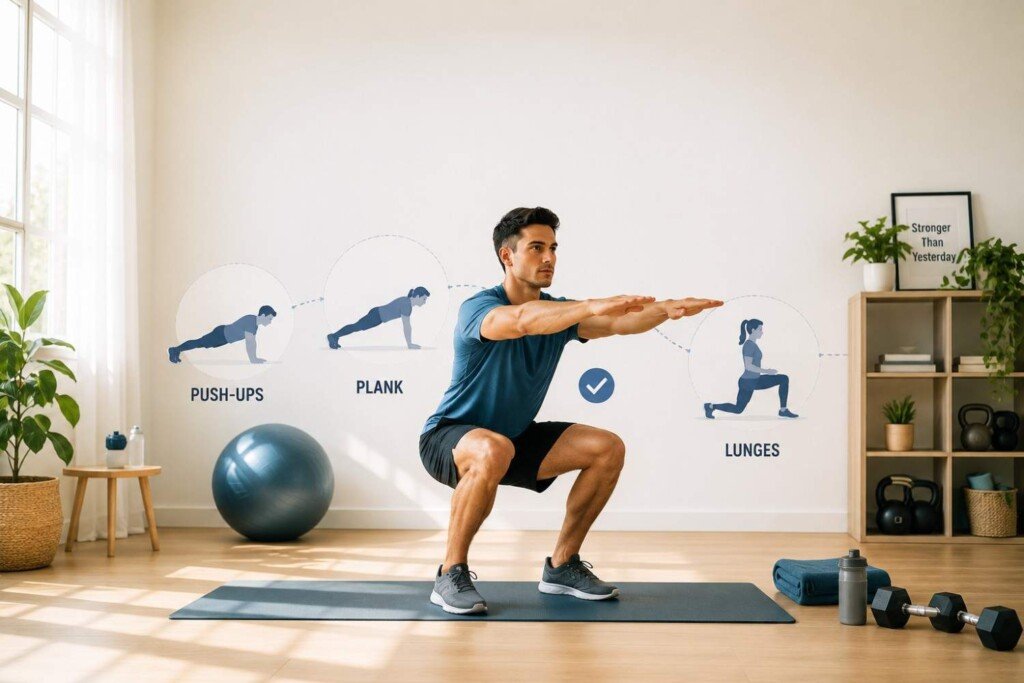

Bodyweight exercises for beginners are simple strength-training movements like squats, push ups, planks, and lunges that use your own body weight as resistance instead of gym equipment. They’re the safest, most accessible way to build strength, improve mobility, and develop consistent workout habits before progressing to weighted training.
If you’ve never worked out before, or you’re returning to fitness after a long break, bodyweight training is where almost every credible coach recommends you start. No gym membership, no equipment, no confusing machines just your body, a bit of floor space, and a plan you can actually stick to.
This guide walks you through everything a true beginner needs: the core movements, a sample weekly routine, common mistakes, and how to know when you’re ready to level up.
Table of Contents
- What Are Bodyweight Exercises?
- Why Bodyweight Training Is Ideal for Beginners
- 7 Essential Bodyweight Exercises for Beginners
- Sample Beginner Workout Routine (Weekly Plan)
- Common Mistakes Beginners Make
- When Should You Hire a Trainer Instead of Going Solo?
- How to Progress Beyond Beginner Level
- Conclusion
- FAQs: People Also Ask
- About the Author
What Are Bodyweight Exercises?
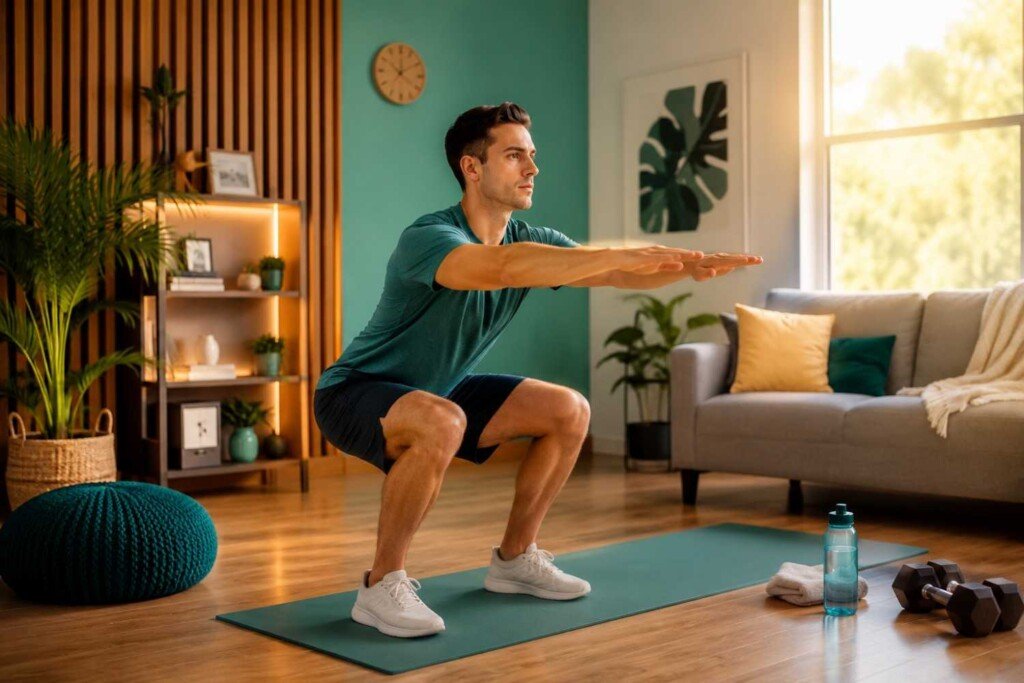
Bodyweight exercises are movements where your own body supplies the resistance — no dumbbells, no machines, no bands. Squats, push-ups, planks, glute bridges, and lunges are all classic examples. Physical therapists and strength coaches commonly use them because they build a foundation of movement control, joint stability, and muscular endurance before someone starts lifting external weight.For beginners specifically, bodyweight training solves three problems at once: it removes the intimidation factor of gyms and equipment, it’s low risk for joints and connective tissue that haven’t been trained before, and it teaches correct movement patterns (like hip hinging and core bracing) that carry over directly into weighted training later.
Why Bodyweight Training Is Ideal for Beginners
| Reason | Why It Matters for Beginners |
| No equipment needed | You can start today, in your living room, with zero cost |
| Lower injury risk | Movements are self-limiting — your own strength controls the load |
| Builds movement literacy | Teaches squat, hinge, push, pull, and core patterns used in every future workout |
| Scalable difficulty | Easy to regress (make easier) or progress (make harder) without new equipment |
| Improves consistency | Fewer barriers to starting = higher chance of building a lasting habit |
Research in exercise science consistently shows that consistency not workout intensity is the strongest predictor of long term fitness results for beginners. Bodyweight training removes friction, which is exactly why it works so well as a starting point.
7 Essential Bodyweight Exercises for Beginners
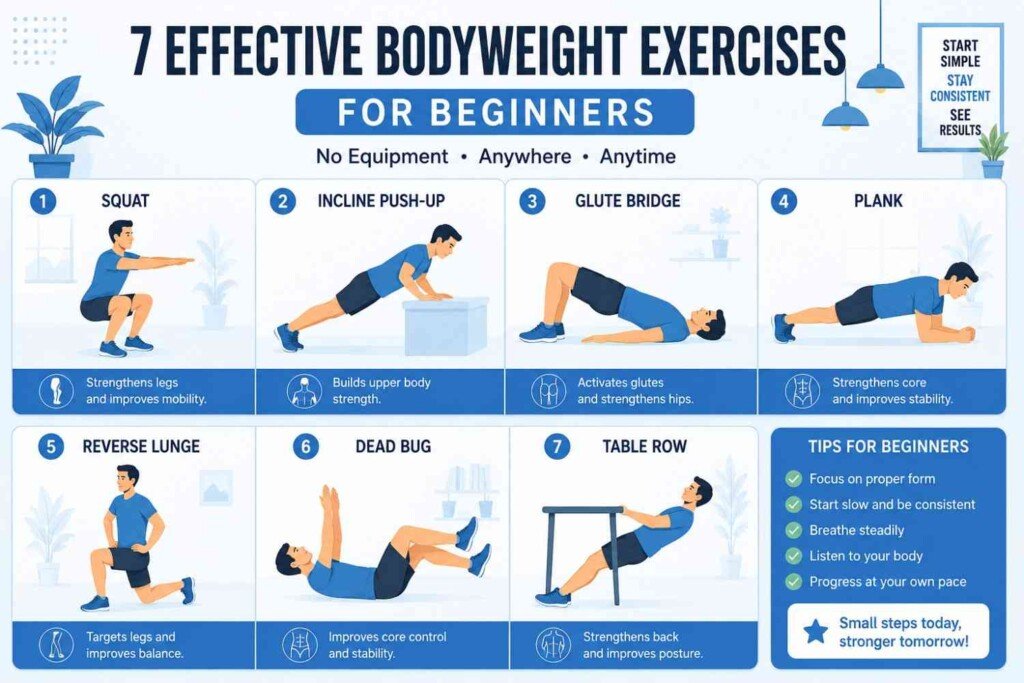
Here are seven foundational movements that cover every major muscle group. Master these before adding complexity.
1. Bodyweight Squat
Works: quads, glutes, hamstrings, core Stand with feet shoulder-width apart, push your hips back and bend your knees as if sitting into a chair, keep your chest up, and return to standing.
2. Incline or Knee Push-Up
Works: chest, shoulders, triceps, core Beginners should start with hands elevated on a table or countertop, or push-ups from the knees, to build strength before attempting full push-ups.
3. Glute Bridge
Works: glutes, hamstrings, lower back Lie on your back, knees bent, feet flat. Lift your hips until your body forms a straight line from shoulders to knees, then lower slowly.
4. Plank
Works: core, shoulders, lower back Hold a forearm plank position with a straight line from head to heels. Start with 15–20 seconds and build up gradually.
5. Reverse Lunge
Works: quads, glutes, hamstrings, balance Step one leg backward and lower until both knees are close to 90 degrees, then push back to standing. Reverse lunges are gentler on the knees than forward lunges for most beginners.
6. Standing Bird Dog / Dead Bug
Works: core stability, coordination These low-impact core exercises teach you to brace your core without straining your lower back — an important skill before doing harder ab work.
7. Wall or Incline Row (using a table edge or sturdy furniture)
Works: back, biceps Since pull-ups are too advanced for most beginners, an incline row using a sturdy table lets you train your back muscles safely.
Sample Beginner Workout Routine (Weekly Plan)
| Day | Focus | Exercises |
| Monday | Full Body | Squats, incline push-ups, glute bridges, plank |
| Tuesday | Rest or light walk | Active recovery |
| Wednesday | Full Body | Reverse lunges, wall rows, dead bugs, plank |
| Thursday | Rest or light walk | Active recovery |
| Friday | Full Body | Squats, push-ups, glute bridges, lunges |
| Saturday/Sunday | Rest | Recovery and mobility stretching |
Beginner guideline: 2–3 sets of 8–12 repetitions per exercise, with 60–90 seconds of rest between sets. Focus on form over speed for the first 4–6 weeks.
Common Mistakes Beginners Make
- Skipping the warm-up — Even 5 minutes of light movement reduces injury risk significantly.
- Rushing reps — Slower, controlled movement builds more strength than fast, sloppy reps.
- Ignoring rest days — Muscles grow and adapt during recovery, not during the workout itself.
- Comparing progress to advanced athletes — Beginner progress is measured in weeks and months, not days.
- Poor core bracing — Especially during planks and push-ups, letting the hips sag reduces effectiveness and strains the lower back.
If you’re finding it hard to self-correct these mistakes, this is often the point where working with a professional makes the biggest difference particularly if you want faster, injury free progress. Our guide on the benefits of hiring a luxury personal trainer breaks down exactly how personalized coaching accelerates results for beginners who want a more guided, premium experience.
When Should You Hire a Trainer Instead of Going Solo?
Bodyweight training is beginner-friendly, but not everyone wants — or should — figure it out alone. If you have a previous injury, struggle with motivation, or simply want a faster, more structured path to results, a personal trainer can tailor a program specifically to your body and goals. For those who want a premium, fully personalized coaching experience, it’s worth reading about the benefits of hiring a luxury personal trainer, which covers one-on-one programming, accountability, and advanced technique correction that self-guided training can’t fully replicate.
How to Progress Beyond Beginner Level
Once bodyweight squats, push-ups, and planks feel comfortable for 3 sets of 12–15 reps, it’s time to increase difficulty:
- Add reps or time before adding difficulty (e.g., 60-second planks before weighted planks)
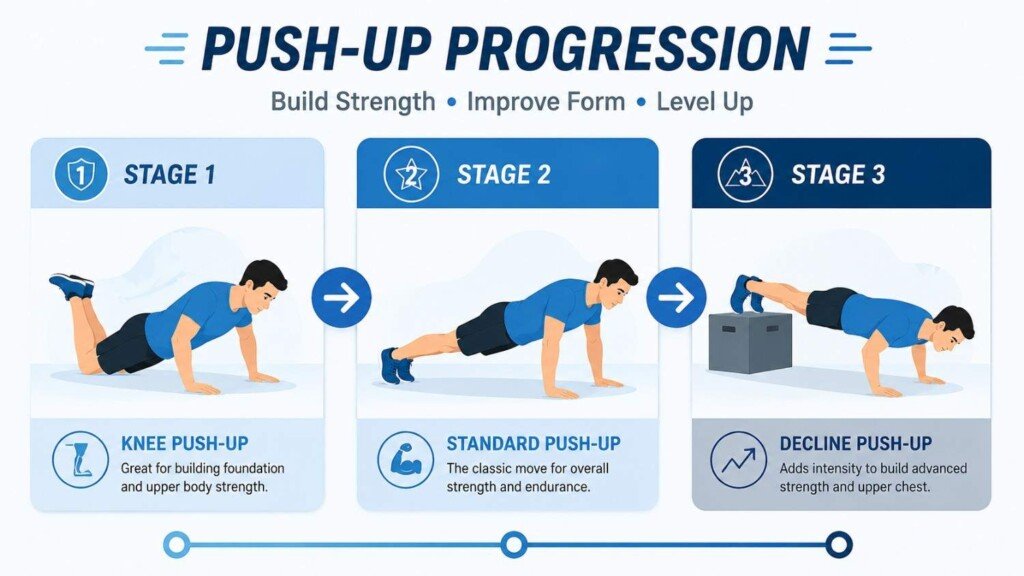
- Progress push-ups: knee push-ups → full push-ups → decline push-ups
- Progress squats: bodyweight squats → jump squats → single-leg squats
- Add tempo: slow down the lowering phase (3–4 seconds) to increase difficulty without new movements
- Introduce light equipment: resistance bands or light dumbbells once bodyweight strength plateaus
Conclusion
Bodyweight exercises are the smartest starting point for anyone new to fitness — they require no equipment, carry low injury risk, and build the movement foundation every future workout depends on. Start with the seven exercises covered above, follow the sample weekly routine, and focus on consistency and form rather than speed or intensity. As squats, push-ups, and planks start feeling easier, use the progression tips to keep challenging your body. And if you ever feel stuck or want faster, more personalized results, exploring the benefits of hiring a luxury personal trainer is a great next step. The most important thing right now isn’t perfection — it’s simply getting started and showing up consistently.
FAQs: People Also Ask
How many days a week should a beginner do bodyweight exercises? Most beginners do well with 3 non-consecutive days per week (e.g., Monday, Wednesday, Friday), allowing muscles to recover between sessions.
Can bodyweight exercises build muscle for beginners? Yes. For untrained beginners, bodyweight exercises provide enough resistance to build noticeable strength and muscle tone, especially in the first 8–12 weeks of consistent training.
Do I need any equipment to start bodyweight training? No equipment is required. A yoga mat and comfortable clothing are helpful but optional — floor space is enough to get started.
How long before beginners see results from bodyweight exercises? Most beginners notice improved strength and endurance within 3–4 weeks, with visible physical changes typically appearing around 8–12 weeks of consistent training.
Are bodyweight exercises enough, or do I eventually need weights? Bodyweight training is enough to build a strong foundation. Many people add weights later to continue progressive overload, but it isn’t mandatory for general fitness goals.